

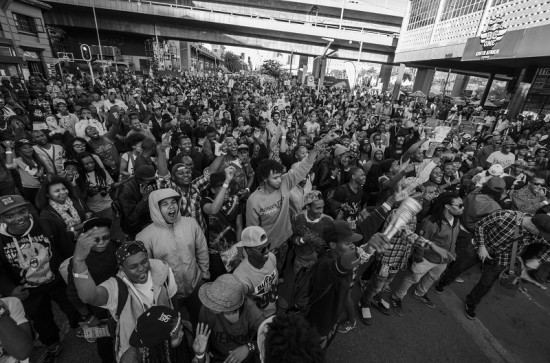
Audience at the Redbull Stage during the Producer Challenge
Sunday 27th of April is Freedom Day in South Africa, a day steeped in great history for the country’s inhabitants. What I did not know, was how this day took on so many different meanings to the people of Mzansi. For some of the so-called ‘born frees’ (South Africans born in 1994, the year of the country’s first democratic elections) the significance of the freedom they enjoyed was a concept they did not fully grasp & appreciate.
I woke up early that morning to catch a flight to Johannesburg. A few weeks earlier I had made the decision to give HIFA 2014 a miss to attend the Back To The City Festival – an event which has been marketed as one of Africa’s fastest-growing festivals, & the continent’s largest annual hip-hop showcase.
I arrived at the Mary Fitzgerald Square in Newtown & was immediately struck by the diversity of the crowd in attendance. Skaters were ollying & practicing kick flips on the pavement behind the Sophiatown restaurant opposite the Square. Graffiti artists were mapping out their designs on the adjacent wall while a mix that consisted mainly of golden era East Coast rap began to play as the fans walked in & waited for the gates to the festival to be opened.
Throughout the festival, Freedom of Expression was a theme I noticed again & again. It is one of the very founding principles of hip-hop culture: the right to express yourself through music, dance, words, dress, & art.
The organizers of Back To The City did a great job in ensuring those vital aspects of the culture are preserved & celebrated. The murals, the skate park, & the performance stages all played their part.
As I moved towards the venue’s entrance I spoke to some of the attendees & get their views of Freedom Day, the festival & its significance. The majority that I spoke to all had their own definition of what Freedom meant. Some struggled to articulate why Freedom Day had any significance at all.
My next line of questions focused on the artists performing on the day & who the attendees were hoping to see perform. Most of them were able to list their favourite local acts but struggled to provide any more detail beyond that.
Throughout the rest of the day I asked myself several questions;
Was the festival doing enough to ensure the message they are trying to promote about Freedom Day received by attendees? The organizers had chosen hip hop as the vehicle to convey this message, how was it being used? Was I adopting an elitist view by expecting the people I spoke to view the event the same way I did?
I’m still searching for the answers, but 21,000 hip-hop fans converged on Newtown that day to be part of the culture; part of the movement. They were there to celebrate their right to freedom, whether they fully understood it or not.
In that respect Back To The City was a monumental success & I am glad I made the decision to attend. On paper, I loved everything about this day – Its goals & themes. On paper….
I also noticed a great deal of flaws that I feel need to be addressed at future iterations of the event.
The only other festival that I can fairly compare to Back To The City is Zimbabwe’s Shoko Festival. Like Back To The City it is a festival celebrating Hip Hop, spoken word & expression. The two festivals both have hip-hop performances, dance battles, graffiti murals, & workshops for artists & fans.
Where they differ is how all these are executed. Shoko is a week-long event. It gives attendees the option to choose which events to attend & ensure they gain as much or little of the Festival as they would like.
Back To The City gave me no such option. When I first saw the line-up & running order of the event, I had my doubts about fitting so much into an event that ran for half a day. I asked Osmic about it & he assured me it wouldn’t be a problem. Sadly he was wrong.
There’s too much happening at the same time to allow one to take in the best parts of the festival without missing something. As an attendee you have to plan out who you want to see across 3 stages running simultaneously, including other activities..
As with any festival, there will always be clashes where hard decisions have to be made. But with the frantic nature of the sets at Back To The City, itemising your itinerary becomes almost impossible
Why not stretch this all over 2 days or a full weekend? I know organizers are tied to Freedom Day but this needs to be addressed. Mary Fitzgerald Square is also a public space so the logistics of an event over multiple days might not be possible at that time of the year, but surely something can be done. One of the things Shoko has done to address this is to hold all workshops, graffiti & art installations at a separate location. I had the option to attend most of the workshops during the day & then decide which performances to attend after sunset.
Stretching it over a longer period of time will also address the issue around the time allotted for performances. A 10-15 minute set simply isn’t long enough for more accomplished artists; it disrupts the energy of their performance & leaves the crowd frustrated.
Another thing that concerned me was how the artists were treated. The festival had over 20,000 attendees, yet artists, journalists & VIP ticket holders all had access to the same VIP area which was no bigger than a shipping container. Not only is this inconvenient, it is a serious security & safety risk.
The backstage area had similar issues: no tent or “green room”; no complimentary meals, snacks, or hot beverages; not even a lawn chair to sit on! As the sun set, temperatures dropped drastically & I was standing in the freezing cold with Tumi, Gingerbread Man & the Cap City Crew while we braved the elements as they awaited their sets.
For a festival of this magnitude this shocked me. I’m not advocating that artists are to be revered & wrapped in cotton, but surely these are issues that can easily be addressed.
It is hard to try & explain my first Back To The City experience & opinion in a few words. The best explanation I can give is that it is the perfect microcosm of how I view hip-hop: an avenue for people seeking a voice to come together & express themselves. Like hip-hop, Back To The City is laden with the potential to make a serious social impact, the organisers just need to take a step back, listen to criticism and find a solution that benefits everyone at next year’s edition. Back To The City could very well be the largest festival of its kind in the region, but it could learn a lot from other festivals to ensure the message they are trying to share about the significance of the 27th of April is received by attendees willing to listen.
For more images from the fest check out our Facebook & Instagram pages. Congratulations to our winners of our Back To The City Giveaway, who walked away with free tickets & an African Hip Hop T-Shirt courtesy of Mutopo Clothing.


Pingback: Document(ation) Of A Rev[ival]olution… | ntsoana()