

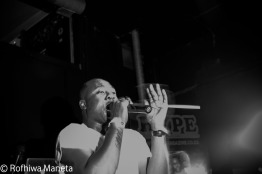
Reason performing at Hype magazine’s Cape Town 10-year-anniversary celebration.
November 14 2014, Reason stands in the dimly lit Cape Town Red Bull Studios common area in front of an audience of about 40 people. He looks relaxed as ever in a loose-fitting white T, black jeans tattered at the knees and black and red classic Air Jordan 1 kicks. Rather too relaxed for an artist who is about to play a presentation of his latest album, Audio High Definition, in public for the first time. It’s three days before the official release of the emcee’s third album.
The presentation comprises visual effects and clips from his previous music videos mashed up with the music from Audio HD.
In the clip, he talks in detail about the making of the album, such as his Motif label boss Tumi Molekane’s absence during its making (in contrast, the poet-emcee was there during the entirety of his previous album Audio 3D’s making). This time around, it was just him and producer Instro in studio. “I would come with a beat and be like ‘yo, I got this dope beat’ and Instro would be like ‘na, this beat sounds like it was made on Fruity Loops’” he reveals. He buries his face on his phone while the presentation is played and projected onto a white screen.
The first track is an ensemble of a deep electronic bassline, a strident synth and Reason’s simplistic yet engaging scripts. It sets the tone for the rest of the album, which consists mostly of upbeat music and sincere and eloquent scripts as we’ve grown to expect from Reason.

Reason’s manager/DJ, Akio and producer, Instro, who the rapper works closely with.
“Mina ng’khulel’eTembisa nase K1/ Bang’khulisa ngespaza shop, hamb’obuza ‘bangani bam,” the rapper who raps mainly in English spits in swaggering Zulu on a track called “Audio High Definition”, and to everyone’s surprise.
Taking questions from the audience later on, he explains his move to rap in Zulu: “When I was making this album, I thought ‘I want to rap, I’m gonna rap’. When we were making Audio 3D, we were showcasing the different colours that we could tap into,” he says. “And rapping in ‘vernac’ IS rapping in South Africa.”
He is quick to clarify that it was to prove a point – as opposed to succumbing to pressure – that he did the song. The emcee seems to know his lane well. He hasn’t hitched a ride on the new age kwaito bandwagon.
An audience member asks him how he manages to stay himself in a world teeming with trends, to which he responds: “I don’t lock myself up. I go to clubs, I sit, I drink, I learn their vibe, I figure out what they like and how they react to songs. I ask myself ‘what is it about that song that just made that girl wanna just lose it like that?’ I hear songs that get dropped today and immediately get played and I ask how that happens because I drop songs that don’t get played for like two months. They’ll be like ‘Reason. The Mass, 2 Cups Shakur, fine’ whereas with some cats it’s like ‘What?! Boss Zonke! Now!’”
The East Rand-born emcee (by way of Katlehong) has appeared in a handful of club songs since he managed to break into the mainstream with his 2012 hit single “Do it Like I Can”. “I’m literally doing it just to say I can do it,” he says of rapping on those “turn up” songs. “A real emcee can jump on anything and tear it apart. And also, who’s gonna tell [DJ] Speedsta or [DJ] Switch: ‘No, let’s do a serious song’? Speedsta and Switch want bangers. So I’ll save that stuff for the features.”
With his own songs, though, it’s a different story. “With the album stuff, I’m there every week. If I do something that’s light, I wanna come back next week and change it,” he says. But even when Reason gets on a club song, he’ll still be “real”.
“Even when I get on that ratchet shit, it’s still gon’ be Reason. As much as a track like [DJ Fanatic’s] “Keep Debiting” is a nice club song, this guy’s actually talking about his mom, his dad, his debts, his problems, which is unrapper-like. Another rapper would be like ‘I keep debiting ‘cause my money long, I got bitches, I got bitches, I got cars…’”
Reason who, prior to releasing Audio High Definition, had been releasing awe-inspiring monthly freestyles for the whole year, wasn’t nominated under “Lyricist of The Year” – a category he won in 2013 – by the organisers of the South African Hip Hop Awards. I ask him how he feels about that. “The South African Hip Hop Awards are a new thing. It’s gonna take a while to get things like those right,” he responds. “When it came to lyricism, they were looking at things like albums. They didn’t actually realise that dropping a freestyle also counts as lyricism. There’s a bunch of other things they actually make mistakes about and I’m not even mad; I’m not emotional. I think the important thing is that we help those awards become better than the Channel O Awards and the SAMAs.”

Reason performing at the Jamla show towards the end of 2014. Image by Andiswa Mkosi.
He’s more upset by how low hip hop fans’ standards have become than he is about not getting a nomination. “I’m actually interested to know why, after those freestyles, people didn’t ask rappers why they don’t do that. Rappers, today, compete with tweets, Instagram posts and watches and shit. But where’re the verses? Where’re the raps? I’m actually disappointed in the consumer because you are so easy on these rappers. A lot of rappers say things and tomorrow come say a different thing and you guys will say nothing. Some act hard, then hard shit happens and then they cry. But you guys won’t say anything but ‘yo, you’ve been doing all these freestyles, are you gonna do any more?’ But what about the other guys?”
The internet has made it easier for artists and fans to connect directly. Our Twitter timelines are eternally being flooded by rappers retweeting their fans’ compliments (hello, AKA). But it being easy also means every Themba, Mandla and Sipho are doing it. We get tweeted links to up-and-coming rappers’ free music everyday. If it bothers us nobodies, then I can only imagine how chafing it is for a guy in Reason’s position, who everyone’s trying to reach out to. And in a world where everyone is looking for approval of some sort, having Reason telling an up-and-coming rapper that he’s tight, let alone working with them, is tantamount to “making it”.
“What’s this thing that Tumi said?” Reason tries to remember, “If I’ve never heard of you, if no one has ever come up to me and said ‘yo, you need to hear this cat, he’s dope!’ then it means you aren’t that dope’” he says, paraphrasing Tumi. “I always tell cats: You wanna get to a point where I wanna call you. I got called by Tumi, man. I got called into that studio,” says the rapper.
Later on, that night, Reason goes on to open for Jamla: North Carolina hip hop producer 9th Wonder and rappers Rapsody and HaLo at The Assembly. He sets the bar high for the Americans and I still believe he gave the best performance of the night. “Now you understand why I’m such a groupie of this guy?” I ask my lady friend as she shakes what I’m hoping she’ll give to me later that night, to Reason’s hits.
Quick facts about Audio High Definition
- The hook to “Endurance”, which is performed by HHP, was written by Towdee Mac. Khuli Chana was supposed to be on the chorus instead of HHP but he got hospitalised after getting shot.
- The skit “The Mind: Please Don’t You Confuse Me” which features Bonang Matheba, was supposed to be a song featuring Queen B herself but everyone decided on the skit instead of a song.
- “The Soul: My Ugly World” is one of Reason’s favourite Reason songs.
- Thandiswa Mazai was only in studio for less than 30 minutes, in and out for “Ungam’biza” which the singer is featured on.
- The beats to “The Soul: My Ugly World” and “Touch the Sky” were remade by Instro after the original producer Aux Cable lost the separates.
- “GaaAHDbody” took the longest to make because, in Reason’s words, “we were just not happy with the hook”.




Pingback: Stalking Reason in Cape Town | Sabelo Mkhabela()
Pingback: South African Slam Poet & ‘Vocal Revolutionary’ Lerato Mokobe, The Youngest TED Fellow | Sabelo Mkhabela()