
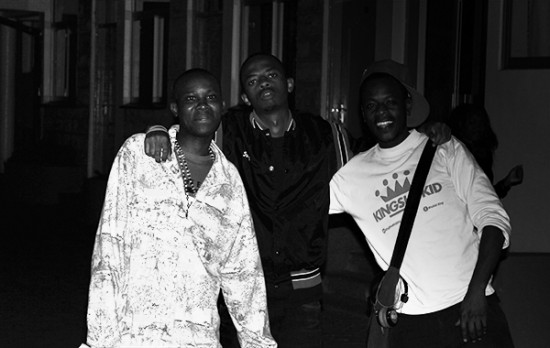
Holly Rahman, GnX & Shukid
A month ago, as I was aboard a plane heading to Nairobi Kenya on an excursion totally unrelated to African Hip Hop. The visit to the East African “IT Capital” was an eye opening experience.
As we neared the destination I expected Nairobi to a hybrid of California’s Silicon Valley , with modern infrastructure but with a distinctly Kenyan flare. What I got was none of the above.
Nairobi is a growing metropolis. Much like the rest of Africa, there is often a striking juxtaposition as first world business interests & developments are unevenly yoked with third world infrastructure. For example the road to the five star-rated Crowne Plaza Hotel is littered with potholes; the roads are narrow & uneven; & traffic is a nightmare.
Once inside, the hotel is furnished like any other the world over,[ in a striking contrast to the exterior]. The only reminder of where you are being the Kenyan staff, their distinct accents and welcoming demeanour.
My knowledge of the Kenyan music scene was not as detailed as I would have liked. Besides the music of acts like Camp Mulla, Octopizzo, Xtatic, Muthoni, Nazizi & Nameless, I knew very little.
I arrived with an open mind and zero expectations. I had met a Holly Rahman, a blogger who also manages a few Kenyan artists by chance, via e-mail. I arranged to meet him along with two of his artists – King Shukid and GnX – to get some insight into the industry and what the outlook for Kenyan hip-hop was.
Even before the meeting, a few things about Kenya & how it approached music struck me. I made it a point to listen to local radio whenever I was in a taxi. I would spend the long commutes stuck in traffic shifting through local radio stations and listening to what Kenyan deejays supported.
In the 4 days I was in Nairobi, the only time I heard anything close to hip-hop or urban music on commercial radio was when they played a genre of music called Kapuka. This music is similar to West Africa’s afro beat with reggae, hip-hop, and pop influences. There was, however a smaller independent station titled Ghetto Radio that played only local urban music. Besides that, local radio sounded like a playlist copied from the Billboard Hot 100 list with a few local tracks just to remind you of where you were.
In Zimbabwe, the face of local commercial radio has seen some massive changes in the last decade. This is down to the 75% local content law spearheaded a decade ago. It was a surprise to realize that Kenyan authorities had not implemented a similar policy
The four of us sat and spoke for over two hours discussing the current state of Kenyan hip-hop, everyone’s hopes for the future, and their opinions on local artists.
Shukid expressed his frustrations of growing up in Canada and embracing hip-hop music only to come back home and be shunned. Shukid moved around quite a bit as a kid, his father was a Kenyan diplomat. He credits Canada & The USA as the 2 nations responsible for his love for hip-hop. He also spoke of how locals hated the fact that he couldn’t speak Swahili despite him never getting the chance to learn the language as a youth as he bounced from country to country.
Shukid led the discussion throughout the two hours, and was very vocal when we discussed local events in Nairobi, how Camp Mulla managed to break through, and what was holding him back.
Shukid feels that local fans only support local acts when they have to and will rarely buy an artist’s work. Piracy, he added, had ravaged the music scene in Kenya to the point that young people don’t understand the concept of paying for content. According to him, there is also a massive disconnect between the lyrical content of the songs being produced and the realities of an artist’s life. Shukid feels that artists blindly replicate American-style bling rap, forgetting that they themselves struggle to earn a decent living wage.
He was very careful with his words when speaking on Camp Mulla. To him they came out at the right time, had a great dynamic, and a machine behind them (Sub Sahara records) that helped ensure their success.
Holly, a mechanical engineer who admits that the pressure to gain a respectable qualification led to his chosen academic path, (“being an artist isn’t a real job in Kenya,” he says) spoke of the struggle to attain any solid recognition in Nairobi.
GnX met Shukid soon after he moved back to Nairobi seven years ago. He is a self-taught rapper, music producer, and sound engineer. He is an integral part of the ID37 clique that Holly,GnX, Shukid & two other Nairobi based artists represent. Namely Kavuela & Faraqummin. ID37 was formed after Shukid & GnX left Coolagang which was another Nairabi based Hip Hop collective.
The three of them spoke at length about the divisions in Kenya’s hip-hop scene, and about how other artists before them had failed to capitalize on their initial success. Shukid, GnX & Holly feel that getting recognition in Kenya is more reliant on who you know, rather than the quality of the music you produce.
I raised the subject about local content and asked why I heard more Katy Perry on this single trip than I have ever heard in my life.
The consensus was that local radio simply didn’t do enough to support local acts. As the conversation wore on, I began to notice the same issues that plagued Zimbabwe’s music scene were repeating themselves in Kenya. Kenyan Hip Hop does not have a strong base of support. The same is true in Zimbabwe.
My next question was why this seemed to be case, but nobody had a definite answer. Yet again, the parallels between Kenya and Zimbabwe unraveled. In Zimbabwe local youths would rather pay to see international acts than pay a fraction of the price to support local. [Kanye West and John Legend were just but a few of the myriad of international acts who’d been to Kenya and performed to sellout crowds].
The conversation wore on though out the night & we discussed a myriad of other issues which I will explore in future blog posts. The topics covered Kenyan Hip Hop pioneers, their failures, future projects & much more. In the next edition we will investigate these issues & review Shukid‘s new double album Sleepless Nights 1 & 2


Pingback: King Shukid - Sleepless Nights 1 & 2 Review - The African Hip Hop Blog
Pingback: GnX - Don't Doubt Featuring Shukid [Official Video] - The African Hip Hop Blog
Pingback: Shukid - You Had Me (Feat. Teach) - The African Hip Hop Blog